Resume vs CV: What's the Difference and Which Do You Need?
A clear explanation for job seekers, graduates, and professionals
CAREER WRITING
2/9/202611 min read
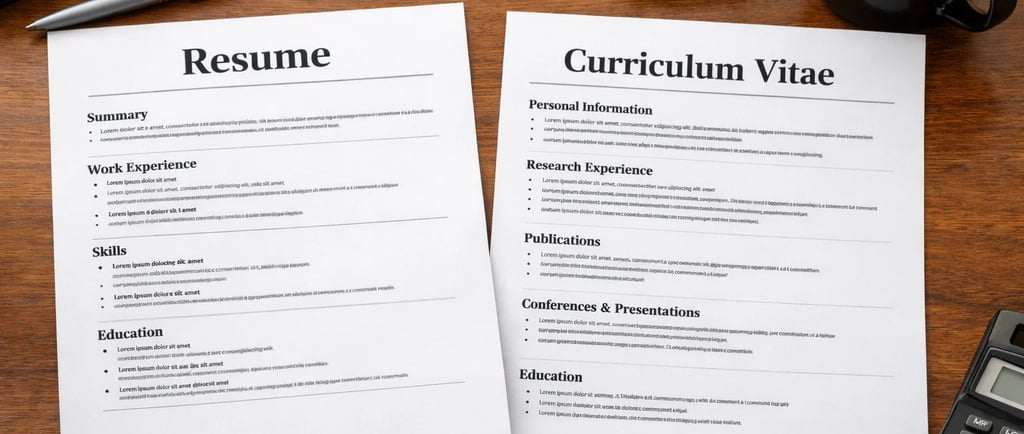
You're preparing to apply for jobs, and you've encountered conflicting advice.
Some job postings ask for a "resume." Others request a "CV."
Your university career center talks about CVs, but American job sites mention resumes. Are these just different words for the same document, or is there an actual difference? And more importantly—which one do you need?The confusion is understandable.
Depending on where you are in the world, your field, and your career stage, the terms "resume" and "CV" can mean different things. Using the wrong document can make you appear unfamiliar with professional norms in your target market, potentially costing you opportunities.
This guide clarifies the resume vs CV distinction, explains what employers expect in different contexts, and helps you choose the right document for your situation.
Why the Confusion Exists
The resume vs CV confusion stems from inconsistent usage across different English-speaking countries and professional contexts.
Regional Terminology Differences
In the United States and Canada, "resume" and "CV" refer to distinctly different documents with different purposes.
In the UK, Ireland, and most of Europe, "CV" is the standard term for what Americans would call a resume, while the American-style resume is rarely used.
In Australia and New Zealand, both terms appear, though "CV" is more common.This geographic variation means that advice appropriate for one region may be completely wrong for another.
An American job seeker following UK guidance might create an unnecessarily long document, while a British candidate following US advice might produce something too brief for their market.
Academic vs. Corporate Contexts
The distinction also varies by sector. Academic, medical, and research positions typically require CVs (in the American sense—comprehensive documents) regardless of location.
Corporate, business, and most private sector roles typically want resumes in North America or CVs (in the European sense—shorter documents) elsewhere.
Casual Interchangeability
Many people use "resume" and "CV" interchangeably in casual conversation, further muddying the waters. Recruiters and hiring managers in specific contexts know exactly what they mean, but job seekers often don't realize the terms have distinct meanings.
Understanding these differences is essential for presenting yourself appropriately in your target job market.
What Is a Resume?
A resume is a concise, targeted document summarizing your relevant professional experience, skills, and qualifications for a specific job or career path. The term comes from the French word meaning "summary."
Length and Structure
Resumes are deliberately brief:
· Standard length: 1-2 pages maximum
· Typical length for most professionals: 1 page
· Acceptable 2-page resumes: Senior professionals with 10+ years of relevant experience
The brevity is intentional. Resumes force you to be selective, including only information relevant to your target role. Anything that doesn't support your candidacy for the specific position is left out.
Standard Resume Sections
A typical resume includes:
Contact Information
· Full name
· Phone number
· Professional email address
· Location (city and state/country, not full address)
· LinkedIn profile (optional but increasingly expected)
Professional Summary or Objective (optional)
· 2-3 sentences summarizing your professional identity and value proposition
· Tailored to the specific role you're applying for
Work Experience
· Job title, company name, location, dates of employment
· 3-5 bullet points per role describing achievements and responsibilities
· Focus on quantifiable accomplishments rather than duties
· Reverse chronological order (most recent first)
Education
· Degree, institution, graduation year
· Relevant coursework, honors, or academic achievements (particularly for recent graduates)
· Certifications and professional qualifications
Skills
· Technical skills, software proficiencies, languages
· Industry-specific competencies
· Sometimes separated into categories (Technical Skills, Languages, etc.)
Additional Sections (if relevant)
· Certifications and licenses
· Professional affiliations
· Volunteer work (if relevant to the role)
· Publications (only if directly relevant; comprehensive lists belong in CVs)
Key Characteristics of Resumes
Tailored to Each Application
Resumes should be customized for each job, emphasizing the experience and skills most relevant to that specific role. You might have several versions targeting different types of positions.
Achievement-Focused
Effective resumes emphasize accomplishments with quantifiable results rather than listing responsibilities. They answer "what did you achieve?" not just "what did you do?"
Concise Language
Resumes use bullet points, action verbs, and concise phrasing. Every word counts. Verbose descriptions or complete sentences are avoided in favor of efficient communication.
Present-Focused While resumes include your work history, they emphasize recent, relevant experience. Older or less relevant positions receive minimal space or are omitted entirely.
When Resumes Are Used
Resumes are the standard document for:
· Most private sector jobs in the United States and Canada
· Corporate, business, and commercial roles
· Positions in startups and technology companies
· Jobs in marketing, sales, finance, operations, and general business
· Career fairs and networking events where brief introductions are appropriate
If you're applying for business roles in North America, you almost certainly need a resume, not a CV.
What Is a CV (Curriculum Vitae)?
CV stands for "curriculum vitae," Latin for "course of life." The term's meaning varies significantly by region, which is the source of much confusion.
The American/Academic CV
In the United States and Canada, a CV is a comprehensive document used primarily in academic, scientific, medical, and research contexts.Length and Scope
· No length limit: CVs can be 2-20+ pages depending on career stage
· Comprehensive: Includes your complete professional and academic history
· Grows throughout your career: You add to it continuously; you don't remove older information
Standard Academic CV Sections
An academic or research CV typically includes:
· Contact information
· Education (with detailed information about degrees, institutions, advisors, dissertation titles)
· Research experience
· Teaching experience
· Publications (complete list, properly cited)
· Presentations and conference papers
· Grants and funding received
· Awards and honors
· Professional affiliations and memberships
· Service and committee work
· Languages and technical skills
· References
The emphasis is on demonstrating scholarly productivity, research contributions, and academic credentials. Everything relevant to your academic career is included, regardless of how long ago it occurred.
When American-Style CVs Are Used
· Academic positions (professorships, postdocs, research positions)
· Medical and healthcare positions (particularly physicians and researchers)
· Scientific research roles
· Fellowship and grant applications
· Some senior positions in research-focused organizations
The European/UK CV
In the United Kingdom, Ireland, most of Europe, and many other countries, "CV" is simply the standard term for what Americans call a resume.
Length and Structure
· Typical length: 2 pages (sometimes 3 for senior professionals)
· Selective: Includes relevant experience, not necessarily everything
· Similar to American resumes: Targeted, achievement-focused, tailored to specific roles
Standard European CV Sections
A European-style CV includes similar sections to an American resume:
· Personal details (sometimes including date of birth, nationality—information not included in US resumes)
· Personal statement or profile
· Work experience (reverse chronological)
· Education and qualifications
· Skills (languages, technical competencies)
· Interests and additional information (more common than in US resumes)
· References (or "available upon request")
The content and approach are similar to American resumes, but the terminology differs. When a UK job posting asks for a CV, they want a document that looks like an American resume, not an American-style academic CV.
When European-Style CVs Are Used
· Virtually all job applications in the UK, Ireland, and most of Europe
· Corporate and business roles outside North America
· International organizations based outside the US
· Most private sector positions in Commonwealth countries
Regional Variations
Some countries have specific CV conventions:
· Europass CV: A standardized format used in some European countries, particularly for EU programs
· Australian/New Zealand CVs: Similar to UK CVs but typically slightly longer (2-4 pages acceptable)
· Middle Eastern CVs: Often include personal information (marital status, photo) that would be inappropriate in Western markets
Resume vs CV: A Direct Comparison
Understanding the key differences helps you choose the right document.
Length
Resume (US/Canada): 1–2 pages maximum
CV (US Academic): 2–20+ pages with no formal limit
CV (UK/Europe): Typically 2 pages, sometimes 3
Purpose
Resume (US/Canada): Used for targeted job applications
CV (US Academic): Required for academic and research positions
CV (UK/Europe): Used for general job applications
Content
Resume (US/Canada): Includes only relevant experience
CV (US Academic): Covers the complete academic and professional record
CV (UK/Europe): Focuses on relevant experience
Customization
Resume (US/Canada): Highly tailored for each role
CV (US Academic): Comprehensive and less tailored
CV (UK/Europe): Tailored to each position
Focus
Resume (US/Canada): Recent and relevant achievements
CV (US Academic): Full scholarly history
CV (UK/Europe): Recent and relevant achievements
Updates
Resume (US/Canada): Revised for every application
CV (US Academic): Updated continuously over time
CV (UK/Europe): Revised for each application
Typical Users
Resume (US/Canada): Business professionals
CV (US Academic): Academics, researchers, and medical professionals
CV (UK/Europe): Most professionals
Which Document Do Employers Expect? Regional Guidelines
Knowing what's standard in your target market prevents basic formatting mistakes.
United States and Canada
For most jobs: Use a resume (1-2 pages, targeted, achievement-focused)Exceptions requiring CVs:
· Academic positions (faculty, postdoc, research)
· Medical positions (physicians, medical researchers)
· Scientific research roles
· Grant and fellowship applications
· Some senior positions in research institutions
If the job posting doesn't specify, and it's a business or corporate role in the US or Canada, assume they want a resume.
United Kingdom and Ireland
For virtually all jobs: Use a CV (what Americans would call a resume—2 pages, targeted, achievement-focused)The term "resume" is rarely used in UK job markets. When UK employers say "CV," they mean a 2-page targeted document, not an American-style academic CV.Exception: Some American companies with UK offices might use American terminology, but this is uncommon.
European Union Countries
For most jobs: Use a CV (2-3 pages, similar to UK style)Note: Some EU countries and programs use the Europass CV format, a standardized template. Check whether this is expected or preferred for your target roles.
Australia and New Zealand
For most jobs: Use a CV (2-4 pages acceptable, more detailed than US resumes)Australian and New Zealand CVs fall between American resumes and UK CVs in length and detail. They're more comprehensive than US resumes but less exhaustive than American academic CVs.
Other International Markets
Conventions vary widely. Research expectations in your specific target country:
· Asia: Varies by country; often includes personal information (photo, age, marital status) that Western markets avoid
· Middle East: Often includes personal details and may be longer
· Latin America: Practices vary by country; research local norms
When applying internationally, research local conventions or consult career writing services familiar with your target market.
Common Mistakes Job Seekers Make
Understanding the resume vs CV difference helps you avoid these frequent errors.
Mistake #1: Using American Terminology in Non-American Markets
Sending a "resume" to a UK employer or calling your document a "resume" when the job posting asks for a "CV" signals unfamiliarity with local norms. Use the terminology expected in your target market.
Mistake #2: Creating a 5-Page "CV" for US Business Jobs
American job seekers sometimes create lengthy, comprehensive documents for business roles because they've heard "CVs are more detailed." Unless you're applying for academic or research positions, US employers want brief, targeted resumes, not comprehensive CVs.
Mistake #3: Submitting 1-Page Documents for UK Positions
Conversely, UK job seekers sometimes create overly brief CVs following American advice. While conciseness matters, UK employers typically expect 2 pages of relevant detail, not the extreme brevity of US resumes.
Mistake #4: Not Tailoring to Each Application
Whether you're creating a resume or CV (European style), the document should be tailored to each role. Generic, one-size-fits-all documents perform poorly regardless of format.
Mistake #5: Including Inappropriate Personal Information
US and Canadian resumes should never include photos, age, marital status, or other personal details that could enable discrimination. UK CVs typically don't include this information either, though some European markets have different norms.Research what's appropriate for your specific target market to avoid including information that could hurt your candidacy.
Mistake #6: Using the Wrong Format for Academic Positions
Applying to academic or research positions with a brief resume when a comprehensive CV is expected makes you appear unqualified or unfamiliar with academic norms. Conversely, sending a 10-page academic CV for a corporate role suggests you don't understand business contexts.
Mistake #7: Assuming Online Advice Applies to Your Market
Much career advice online is US-centric. British job seekers following American resume advice create documents that are too brief. Americans following UK guidance create documents that are too long. Always consider whether advice matches your target market.
When Professional Resume or CV Writing Services Are Helpful
Whether you need a resume or CV, professional career writing services can provide valuable support in certain situations.
You're Applying Across Different Markets
If you're applying to positions in multiple countries with different conventions, professional writers can help you create appropriate documents for each market. They understand regional differences and can ensure your applications meet local expectations.
You're Transitioning Between Academic and Corporate Worlds
Moving from academia to industry (or vice versa) requires translating your experience into a different format with different emphases. Professional CV writing services understand both contexts and can help you position your background appropriately.
You're Unsure Which Format Is Appropriate
If you're genuinely confused about whether you need a resume or CV, or which style is expected in your target market, professional guidance eliminates uncertainty. Career writing services can assess your situation and create the appropriate document.
You Need Documents for Multiple Purposes
Some professionals need both formats—perhaps an academic CV for conference presentations and grant applications, plus a business resume for consulting opportunities. Professional services can create multiple documents that present your experience appropriately for different contexts.
You're Not Getting Interview Callbacks
If you're qualified for positions but not getting responses, your document format or content might be the issue. Professional resume writing services can identify whether you're using the wrong format, emphasizing the wrong information, or missing key elements.
You Want to Ensure Regional Appropriateness
If you're applying internationally or in an unfamiliar market, professional writers familiar with that market's conventions ensure your document meets expectations.
This is particularly valuable when cultural differences affect what's considered appropriate.
To understand how professional services work and what to expect, visit our How It Works page.
For information about investment levels, see our Pricing page.
How to Choose the Right Document for Your Situation
Use this decision framework to determine whether you need a resume or CV, and which style:
Step 1: Identify Your Target Market
Where are you applying?
· US/Canada business roles: Resume (1-2 pages)
· US/Canada academic/research roles: CV (comprehensive)
· UK/Ireland/EU: CV (2 pages, resume-style content)
· Australia/NZ: CV (2-4 pages)
· Other international: Research local conventions
Step 2: Consider Your Field
What sector are you targeting?
· Academic, research, medical: CV (comprehensive if US; 2-3 pages if elsewhere)
· Business, corporate, private sector: Resume (US/Canada) or CV (elsewhere)
· International organizations: Check specific organizational norms
Step 3: Read Job Postings Carefully
What does the posting request?
· If it says "resume" and you're in the US: 1-2 page targeted document
· If it says "CV" and you're in the UK: 2-page targeted document
· If it says "CV" and you're applying to US academia: Comprehensive document
· If unclear: Research the organization and industry norms
Step 4: Check Organizational Norms
What's standard for this employer?
· Large international corporations: Usually follow local market norms
· Academic institutions: Usually want comprehensive CVs (US) or 2-3 page CVs (elsewhere)
· Startups and tech companies: Often prefer brief resumes regardless of location
· Government positions: May have specific format requirements
Step 5: When in Doubt, Ask
If you're genuinely uncertain, it's acceptable to ask the recruiter or hiring manager for clarification. "Could you confirm whether you'd like a 1-2 page resume or a more comprehensive CV?" shows professionalism and attention to detail rather than ignorance.
Practical Guidance for Common Scenarios
Recent Graduate Applying for First Job
In the US/Canada: Create a 1-page resume focusing on education, internships, relevant coursework, and skills. Include academic achievements if impressive.In the UK/Europe: Create a 2-page CV with similar content but slightly more detail about your education and any work experience.
Mid-Career Professional Changing Industries
In the US/Canada: Create a tailored 1-2 page resume emphasizing transferable skills and achievements relevant to your new target industry.In the UK/Europe: Create a 2-page CV with similar focus on transferable experience, perhaps including a strong personal statement explaining your career change rationale.
Academic Applying for Faculty Positions
Anywhere: Create a comprehensive academic CV including all publications, presentations, grants, teaching experience, and scholarly activities. Length will vary based on career stage (2-3 pages for recent PhDs; 10+ pages for established professors).
Academic Considerations for Corporate Roles
In the US/Canada: Create a separate resume (not CV) translating your academic experience into business-relevant achievements. Emphasize project management, research skills, communication, and any industry connections.
In the UK/Europe: Create a 2-page corporate CV (not academic CV) with similar translation of academic skills to business contexts.
Professional Applying Internationally
Research target country norms specifically. Consider working with career writing services familiar with your target market to ensure your document meets local expectations while presenting your experience effectively.
The Bottom Line: Choose Based on Context
The resume vs CV question doesn't have a universal answer.
The right choice depends on:
· Where you're applying: US/Canada business roles need resumes; UK/EU roles need CVs (which are similar to US resumes); US academic roles need comprehensive CVs
· What field you're in: Academic and research positions have different expectations than business roles
· What the job posting requests: When specified, follow the posting's terminology
· What's standard in your target market: Research local conventions
The most important thing is understanding that these terms mean different things in different contexts. A "CV" requested by a London employer is entirely different from a "CV" requested by a US university.
Using the wrong document signals unfamiliarity with professional norms in your target market.When you understand the difference between a resume and a CV in your specific context, you can create the appropriate document that presents your experience effectively and meets employer expectations.
If you're unsure whether you need a resume or a CV—or if you need help creating the right document for your target market—our Career Writing Services can help you choose and prepare the appropriate format.
We understand regional differences and can ensure your application meets expectations wherever you're applying.
Writing Services Pro
Structured professional writing services for business, academic, and career advancement.
Contact
contact@writingservices.pro
123-123-1234
© 2026 Writing Services Pro. All rights reserved.